Hedge Trimming in Spring: Why March and April Are Your Second Chance to Shape Overgrown Hedges in Nottinghamshire
Spring hedge trimming in Nottinghamshire done right. We cover Newark and surrounding villages. Find out when to cut, what each hedge needs and how to get in touch.

Spring Is When Hedges Start Pushing Hard, and Timing Is Everything
The moment temperatures lift and daylight stretches past late afternoon, hedges in Nottinghamshire wake up fast. Privet puts on soft new growth almost overnight. Laurel throws out thick, glossy shoots. Conifer tips begin to extend. If you wait too long, what could have been a tidy hour's work becomes a half-day battle with woody growth and a skip full of clippings.
Spring hedge trimming is one of those jobs where timing genuinely matters. Cut too early and you risk catching a late frost on fresh wounds. Leave it too late and you're chasing the hedge rather than managing it. Get it right and your hedge looks sharp all summer with minimal effort needed later on.
We work across Newark-on-Trent, the surrounding Nottinghamshire villages and the wider area, and spring is one of our busiest periods for hedge work. Here is what we know about doing it properly.
When Exactly Should You Trim Your Hedge in Spring?
There is no single date that works for every hedge. It depends on the species, the weather that year and what the hedge needs.
As a practical guide for Nottinghamshire:
- Privet responds well to a light trim from late April onwards, once the worst frost risk has passed. It grows fast and benefits from an early tidy to keep width in check.
- Laurel is best trimmed from May. Use secateurs or a hedge trimmer with large blades rather than a small-bladed trimmer, which can shred the leaves and leave a brown, ragged finish.
- Conifer (leylandii, thuja and similar) should not be cut back into old brown wood. Spring trimming works well on new green growth from May, keeping the shape tight without triggering die-back.
- Yew is more forgiving and can be trimmed in spring and again in late summer. It tolerates harder cutting than most conifers and responds well to shaping.
- Native hedges (hawthorn, blackthorn, field maple) are a different matter. These are nesting habitat from March through to August, so we do not cut them during that window. Any work on native hedging is done outside the bird-nesting season.
One thing we always check before cutting: whether birds are actively nesting. It is not just good practice, it is a legal requirement. If we see active nests, we leave that section alone and return once the season is clear.
Width Matters as Much as Height
Most people think about hedge height. Far fewer think about width, and that is where a lot of hedges in Nottinghamshire end up in trouble.
A privet that has been topped every year but never reduced sideways will eventually take over a path, push into a fence or block a driveway. The same applies to laurel and conifer. Width creep is slow enough that you barely notice it year on year, but after a few seasons you can easily have lost half a metre of garden on each side.
Spring is a good time to address width because the hedge has not yet put on its full season's growth. Cutting back before that new growth extends means less waste, a cleaner finish and a hedge that stays in proportion.
"The guys cut back some very overgrown shrubs and reduced the width of a ridiculously thick privet hedge for me. They were professional, polite and efficient, did a great job and left no mess behind. I'd definitely use them again." , Sue Hartley
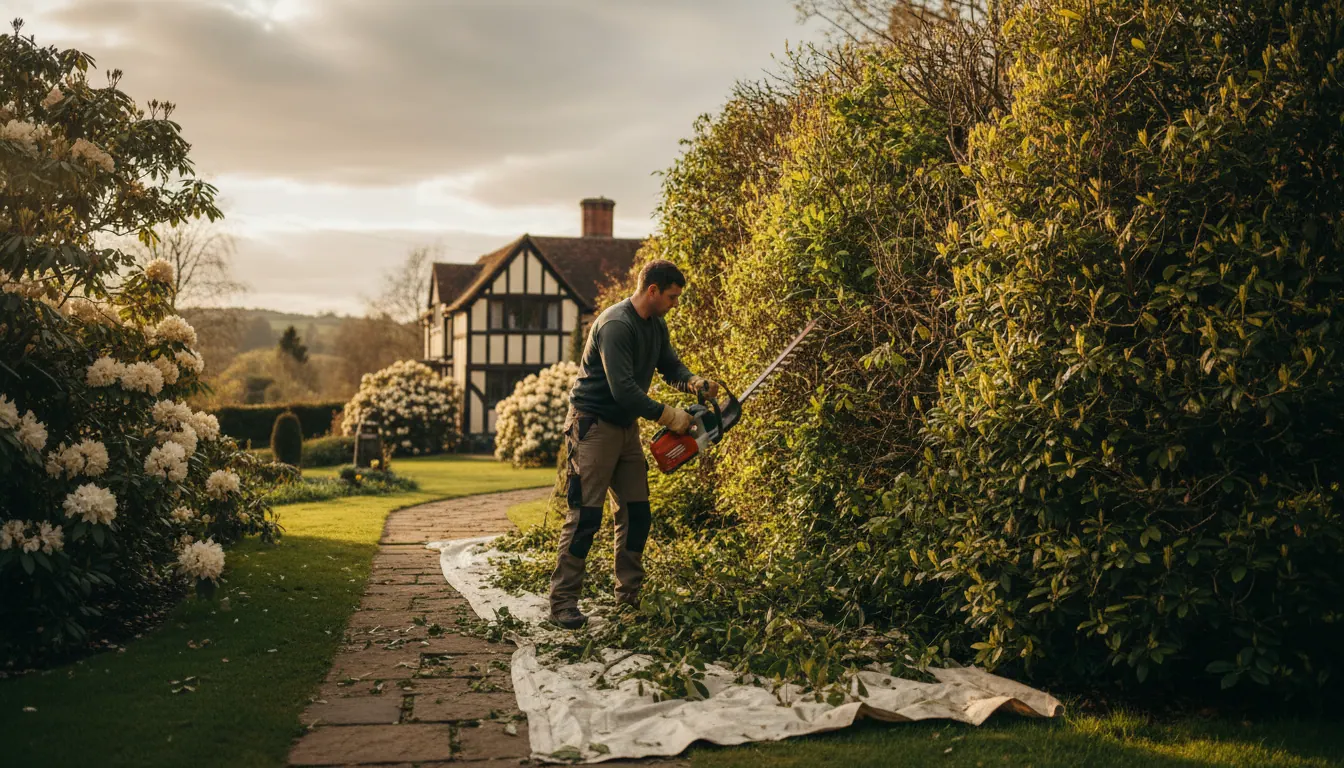
Sue's privet is a good example of what we see regularly around Newark and the villages. A hedge that has been left to bulk out over several seasons needs a proper width reduction, not just a surface trim. We do that work properly, taking it back to where it should be and leaving a clean, flat face that grows back evenly.
For more on why width reduction is often the more important cut, take a look at our article Overgrown Privet Hedge? Here's Why Width Reduction Matters More Than Height.
What We Actually Do When We Arrive for a Spring Hedge Trim
No two hedges are the same, so we always look at what is in front of us before we start. Here is how a typical spring hedge job runs:
- Assess the hedge. How much growth is there? Are there any signs of nesting? Is the base clear or is there a build-up of old clippings and debris?
- Agree on the shape. Height, width, the angle of the top, whether any sections need harder cutting than others. We do not just start trimming without knowing what the finish should look like.
- Cut in the right order. Sides first, then top. This keeps the profile consistent and avoids having to re-cut areas you have already done.
- Clear everything. All clippings, trimmings and green waste are taken away as part of the job. We do not leave bags at the kerbside or clippings on the lawn.
- Final check. We step back, look at the line and tidy any stray growth before we leave.
We are fully insured and aim for 100% customer satisfaction on every job. That is not a marketing line. It means we do not pack up until the hedge looks right.
Hedges We Work With Across Newark and Nottinghamshire
We trim and shape all the common hedge species found in gardens across this part of Nottinghamshire:
- Privet (height and width reductions, formal shaping)
- Laurel (including large-leafed cherry laurel, which needs careful cutting to avoid browning)
- Conifer (leylandii, thuja, cypress, kept tight and proportionate)
- Yew (formal shaping and topiary, as well as standard maintenance)
- Box (low hedging and topiary forms)
- Beech and hornbeam (these hold their dead leaves through winter, giving year-round structure)
For more detail on timing and technique for laurel and conifer specifically, our article on Conifer and Laurel Hedge Trimming: Timing, Height and Why It Matters in Dry Spells covers the key points.
Why Spring Trimming Sets You Up for the Rest of the Year
A hedge that is trimmed properly in spring is far easier to maintain through summer and into autumn. You are working with the hedge's natural growth cycle rather than against it. New growth after a spring cut comes in dense and even, which means the hedge fills out neatly rather than throwing up uneven spikes and gaps.
Autumn is the other key trimming window, particularly for privet and laurel. If the spring cut is done well, the autumn job is quicker and the hedge holds a better shape through winter. Think of it like fitness: the consistent work through the year is what keeps things in peak condition. One big effort after years of neglect is harder, more expensive in time and effort, and takes longer to recover from.
Frequently Asked Questions About Spring Hedge Trimming in Nottinghamshire
Can you trim a hedge in spring if birds might be nesting? You need to check before you cut. Active nests with eggs or chicks must not be disturbed. The nesting season broadly runs from March to August. We always look for signs of nesting before starting any hedge work, and if we find active nests we leave that section until the birds have finished. It is not just good practice, it is a legal obligation.
How short can I cut my conifer hedge in spring? This is one of the most common questions we get. Conifers (particularly leylandii) will not regenerate from old brown wood. You can trim the green growth back, but cutting into the brown zone will leave permanent bare patches. Spring trimming should focus on new green growth only. If a conifer hedge has been left to get very large, the options are limited, so regular trimming from an early age is the best approach.
My privet hedge is very wide. Can that be sorted in spring? Yes. Spring is actually a good time for a width reduction on privet because you are getting ahead of the new season's growth. We cut back to the correct width, remove all the waste and leave a clean face. The hedge then grows back evenly through the season.
How often does a hedge need trimming in Nottinghamshire? Most formal hedges (privet, laurel, conifer) benefit from two cuts a year: one in spring and one in late summer or early autumn. Yew and box can often be done once a year if growth is modest. Native hedges are cut outside the nesting season only. We can set up a regular maintenance schedule if you want the hedge kept on top of throughout the year.
Get Your Hedge Sorted This Spring
If your hedge has put on a winter's worth of growth and needs bringing back into shape, now is the time to get it done before the season runs away. We cover Newark-on-Trent and the villages across Nottinghamshire, and we take all green waste away with us.
Call us on 07704 442169 to tell us what you have got and we will arrange a visit. No obligation, no fuss, just a straight conversation about what the hedge needs and when we can get to it.